

Spring Gardens Report Card: A+ for Blooms!
So, here’s the update on how my Spring blooming combos worked out this year. A lovely year all in all with a nice early bloom show for our Spring Party in mid-April and a perfect peak show just in time for our Mother’s Day Party.


Here is the final result for the always popular mixed planting of Papaver commutatum “ Ladybird Poppy” with California native Nemophila menziesii “Baby Blue Eyes” and tall, white, cottagey classic annual Agrostemma githago ‘Ocean Pearls’ or “White Corncockle”. A fool proof-slam dunk Springtime combination – just imagine these plants repeated in groups over a larger space!
Another lovely poppy to consider for these spring combinations is Papaver hybridum 'Raspberry Breadseed'. Its rich raspberry-pink flowers bring a deeper, more romantic color note to the airy mix of annuals. Like other annual poppies, it appreciates full sun and well-drained soil, and its delicate stems and charming seed pods add movement and interest long after the flowers fade. It would be especially beautiful paired with soft blues like Baby Blue Eyes, creamy whites, or the gentle pinks of other spring annuals.

Here it is a month earlier before the Agrostemma started blooming and when the white California poppies, Eschscholzia californica ‘Alba’, were just coming into flower. Here along the coast in the Bay Area, I plant all these annuals in early February for a maximum bloom-at-the-same-time April – May show. You folks in Southern California would generally plant them in November – December for a late February – March bloom. Basically, they take 2 months from their 4” pot size to burst into all their glory. I plant them pretty darn close together – about 10-12” apart as you can see in my last blog, where I tried to show what they look like just after planting. This helps them fill in fast, look super co-mingly and prevents unattractive bare space (and weeds!).
Big thrill for me! My first-time experiment pairing EASY South African bulb Ixia ‘Buttercup’ and new-to-me Southern California purple California native Phacelia minor was a success! They did bloom at the same time!

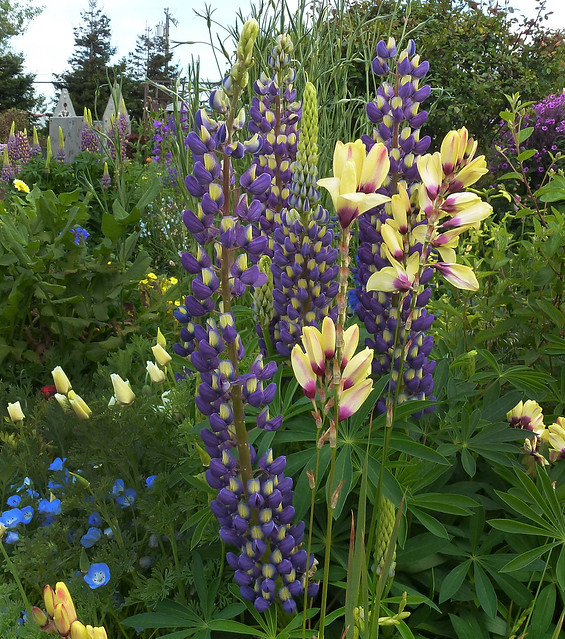
I planted the Phacelia in early March and it worked out just right. Wonderfully rich colored bells were displayed so showily atop quite handsome low foliage. A swell contrast with the Ixia, which has been in the ground for 2 years. And notice the rather perfect purple and yellow bicolored Lupinus regalis ‘Thomas Church’ in the background, making a picture perfect harmonious vertical accent. The Lupine is a perennial and so is the Ixia, which spreads politely in your garden to make a patch of bright primrose prettiness each year. The Phacelia is a bee-magnet extraordinaire and will self-sow for a repeat performance each Spring.
As I mentioned in my March post, I try to make the front bed as visitors entered Annie’s former Richmond nursery as romantic as I can. Not everything worked out as I had imagined it (a really common occurrence!).
This spot is under partial shadow of a tree and I always forget that sun loving plants take longer to bloom with less sun, so my white poppies, Papaver ‘Bridal Silk’, bloomed late and you can only see one bloom on the right side of this photo. Luckily, the white columbine, Aquilegia caerulea ‘Krystal’ took its place. Still pretty, though, don’t you think? Here is a close-up of always beautiful, long lived and long blooming Dianthus ‘Pinkerton’ and “Baby Blue Eyes”.

Lastly, this was the first year I’ve tried this lovely new apricot colored Calendula ‘Bronzed Beauty’ in our gardens.


The gentian Ajuga genevensis I had planned for the front of the bed bloomed late this year, so I added in some quick flowering Viola ‘Bolwes Black’ along with the blue Delphinium bellamosum, peach foliaged Heuchera ‘Marmalade’ and Bellis perennis “English Daisy”. And here’s how it turned out for these photos – I think pretty nice!


That’s one thing I have learned from my years of gardening. You can never quite count on perennials, like the Ajuga, to behave the same way each year or to bloom at the exact same time – that’s one important reason to accessorize and fill in with annuals. You pretty much know what you’re gonna get and that it’s gonna look great. Besides, they self-sow for free plants every new season.
I hope my experiments lend some inspiration. Do stay tuned, as we filmed some nice videos of our Spring gardens this year, featuring more of my favorite “bloom-at-the-same-time combos” in all their fabulous glory! And hey, Happy Gardening everybody!


