
Combination Nation!

Combination Nation – Perfect Plant Pairings for Your Garden
A garden is more than just the sum of its parts. It’s about getting some of the sum to party together at the same time!
For the broader growing overview, see our Nicotiana planting and care guide.
Over the years, we’ve come across some pretty dependable – and dependably pretty – bloom-at-the-same-time plant combinations. And each year, it seems we discover new ones! For us, that’s a huge part of the fun of gardening – and of course, we love to share our tried-and-true, can’t-go-wrong favorites with you!
Our Springtime gardens wouldn’t be the same without our favorite California wildflower and #1 stunner , Nemophila menziesii “Baby Blue Eyes.” Once you’ve edged your Spring garden in this little slice of sky-blue heaven, you’ll be hooked! Which is fine because it looks great with everything, especially other natives that bloom at the same time. Here it looking perfectly perky with Malcolmia maritima and fellow natives Platystemon californicus, Nemophila menziesii ‘Snow White’ and Limnanthes douglasii “Meadow Foam.”

Yup, looks great with the fiery red of Eschscholzia californica ‘Red Chief,’ too!

“Baby Blue Eyes” looking extra fine with red hot Cal Poppy ‘Red Chief.’
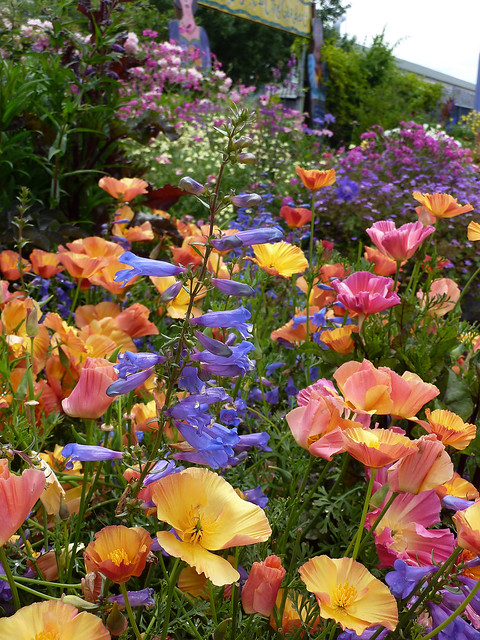
Another knock-out and goof-proof duo we return to again and again is Penstemon heterophyllus ‘Blue Springs’ and Eschscholzia californica ‘Apricot Chiffon.’ You just can’t beat the alchemy between the radiant Poppy and the luminous, almost turquoise Penstemon. Not shy in the bloom department, these two will go to town for months! Deer and drought resistant, they’re fine in low fertility soil and even more bodacious in regular garden soil with some compost!

Okay, so say pastels aren’t really your thing. We can work with that! One of our favorite combinations pits primary gentian blue Anagallis monellii against the solar flare sunshine of Ursinia anthemoides. Throw in the peachy-amber foliage of Heuchera ‘Marmalade’ and you’ve got a fantasically contrastic combo that does great in low water gardens.

From left to right: Heuchera ‘Marmalade’, Anagallis monellii and Ursinia anthemoides. BAM.

Dreamiest spikes of creamiest apricot-blushed-rose blooms make this properly 3′ tall Snapdragon a perfect companion to so many other Spring (and Summer!) bloomers. Here it is canoodling with the long-blooming frothy lace caps of Orlaya grandiflora “Minoan Lace.”


If we handed out awards to our favorite bloomers, Nicotiana alata ‘Lime Green’ would probably sweep the floor, winning “Most Congenial,” Most Stylish” AND “Most Versatile.” Easy and exceptionally long blooming, it gets along with EVERYBODY and looks chic and fabulous doing it. Plant it in containers or in the garden, it’ll thrive in sun (along the coast) or shade, its lime green flowers providing the perfect foil for more vibrant bloomers like Agrostemma githago ‘Milas.’


So there you have it, folks – some simple and stunning combos you can try at home. AND, since so many of these luscious lovelies self-sow, you’ll enjoy future generations of combinations next Spring and beyond!


